A Routine Job With a Big Deadline
Carl’s crew rolled into the forgotten quarry before sunrise, expecting nothing more than mud, overgrowth, and 25 years of neglect. The site had been dormant for decades, but the booming demand for stone forced the company to bring it back fast—and expand it by more than a hundred feet. With heavy machinery, modern tools, and a payout big enough to keep everyone motivated, the job felt straightforward: clear the rubble, strip the walls, dig deeper, move on. The quarry was quiet, isolated, and empty… until the third day reminded them that “empty” doesn’t always mean “harmless.”

The Metallic Clang That Froze Everyone
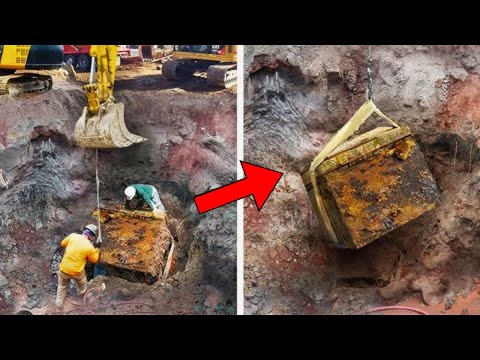
By day three, the crane was already biting into the quarry floor when it happened—a deafening clang so sharp the sound seemed to snap the air in half. Everyone stopped. It wasn’t the dull crack of rock or the grind of gravel. It was metal hitting metal, loud enough to shake nerves loose. Workers dropped tools and rushed toward the fresh hole carved by the crane’s teeth, hearts thumping with the same question: what could possibly be down there? When they leaned over the edge, a yellowish shimmer blinked back at them through dust and broken stone.

The “Safe” That Wasn’t a Safe
Carl ordered hand tools, shovels, and smaller drills—careful excavation now. As the dirt peeled away, the shimmer grew into something far larger than anyone expected, buried at least six feet deep. Rumors spread instantly: a hidden safe, stolen treasure, gold bars sealed away for decades. The crew’s energy spiked as cables were wrapped and the crane began lifting. Slowly, stubbornly, the object rose from the earth like something the quarry itself didn’t want to release. It was huge, corroded, and unmistakably engineered—not a rock, not debris, but something built.

Carl Recognized It Immediately
Once it stood on the quarry floor, the crew circled it like it might suddenly speak. Doors were built into both sides, and Carl tugged one handle—shockingly, it opened. Inside was a thick, reinforced passageway, only a few feet deep, with a clear entrance and exit door. The younger workers stared blankly, still hunting for “treasure,” but Carl’s face tightened with a different kind of understanding. He’d seen old construction gear before. This wasn’t a safe at all. It was a tunnel door—used to support passages underground where tons of earth pressed down from above. And if there was a tunnel door… there was a tunnel.

The Hole Confirmed His Worst Suspicion
Carl walked past the chatter and stared into the crater where the object had been buried. In the shadowed soil, he spotted it—a round opening, clean in shape, disappearing into darkness. The crew gathered behind him, excitement mixing with unease as if they were standing at the mouth of something living. Nobody could see how far it went. Nobody could smell anything except wet rock and old earth. Then Carl did what leaders sometimes do when uncertainty threatens to paralyze everyone—he made the call out loud. They were going in.

A Cry From the Depths
Inside, the tunnel narrowed quickly, older support beams appearing more frequently, their surfaces rusted and brittle. Cobwebs brushed faces. Dust floated in flashlight beams like ash. The air felt stale in a way that didn’t belong to an abandoned quarry—too heavy, too settled. Then the silence broke with a bone-chilling cry echoing down the passage, sharp enough to make several men recoil instantly. Some workers turned back without shame, their fear stronger than curiosity. Carl didn’t stop them. He watched their lights vanish toward the surface, and only five remained beside him as the tunnel pulled them deeper.

The Chamber That Was Still Being Used
The next sound wasn’t a scream. It was softer—almost melodic—like a long, drawn-out whine that seemed to drift ahead and loop back through the stone. Around a bend, the tunnel opened into a wide chamber where rough drawings were carved directly into the rock and old tools rested against the walls, surprisingly organized. Carl motioned for everyone to hide. They crouched behind boulders and dimmed their lights just as a group of elderly men entered, moving slowly but confidently, as if this place belonged to them. One carried an oil lantern, and as it swung, its hinge released that same whining sound—harmless up close, terrifying when echoed through a tunnel.

The Truth That Shouldn’t Have Been Possible
A single accidental gasp gave them away. One of the old men turned and called out, calm but firm, asking who was there. Carl and his crew bolted—then stopped when the voice followed, gentle, promising no harm. When they returned, the lantern-holder introduced himself as John, and the moment Carl explained they’d uncovered the tunnel door above, the man’s face collapsed into shock. Tears came before words. John explained that decades ago an earthquake sealed the tunnels, trapping them deep underground. Rescue never reached them, and eventually the world assumed they were dead. They survived off stored mining supplies, rationed carefully, and built a life beneath the quarry—forgotten, aging, and still living in the dark. And now, because
Carl’s crane hit metal instead of stone, the impossible finally cracked open: a path back to the surface.