A Shape That Shouldn’t Exist
When Dr. Richard Green and his team returned to Antarctica after the long winter, they expected to find the landscape exactly as they had mapped it months earlier. Instead, a massive rectangular plaque of ice stood where nothing had existed before. Its sharp angles and flawless symmetry immediately set it apart from the surrounding ice. Even before drilling, the team sensed something was deeply wrong—or extraordinary—about this formation.

Instruments That Told an Impossible Story
Once drilling began, Dr. Green’s instruments delivered readings that made him go pale. The data didn’t align with any known Antarctic ice formation. Age estimates fluctuated wildly, density readings contradicted expectations, and nothing about the numbers made sense. The more measurements they took, the clearer it became that this ice didn’t form naturally in its current location.

A Surface Unlike Any Ice Before
After a difficult climb, the team reached the top of the ice plaque. What they found there was unsettling. The surface was unnaturally smooth, with no cracks, ridges, or erosion marks common to Antarctic ice. Sunlight reflected evenly across it, creating an almost artificial stillness. It felt less like a glacier and more like a constructed platform frozen in time.
Strange Bubbles Beneath the Ice
As drilling expanded across the plaque, unusual air bubbles began appearing beneath the surface. These were not random pockets of trapped air. Their size, spacing, and patterns suggested deliberate formations. Dr. Green immediately recognized their importance and ordered deeper drilling, suspecting the bubbles were entrances to something far more significant hidden below.

Hidden Caverns Inside the Ice
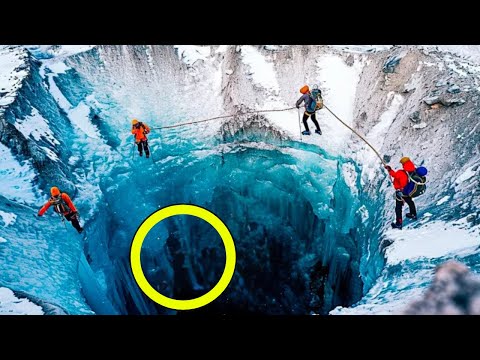
The deeper drill revealed the truth: the bubbles were openings to vast caverns concealed within the iceberg. These hollow chambers were massive, stable, and untouched. The realization stunned the team. Icebergs were never supposed to contain internal cave systems of this scale. Preparations began immediately for a descent into the frozen unknown.
A Frozen World Preserved in Time
Inside the caverns, the team discovered something breathtaking. Animals and unknown entities were perfectly preserved within the ice, as if frozen mid-movement thousands of years ago. Every specimen appeared untouched by decay, offering a pristine snapshot of ancient life. It was as though time itself had stopped inside the iceberg.
Evidence of an Ancient Ecosystem
Further exploration revealed preserved flora, rock formations, and layered ice that told a complex story. This was not ordinary sea ice. The patterns suggested an entire ecosystem had been locked away beneath the surface for millennia. Each layer held fragments of Earth’s distant past, waiting to be decoded.
The Theory That Changed Everything
Dr. Green proposed a groundbreaking explanation: the iceberg was once land ice, displaced by seismic activity and pushed upward from the ocean floor. This would explain the rocks, preserved life, and impossible structure. If true, the iceberg was not just ice—it was a time capsule from a prehistoric world, carrying secrets that could rewrite Earth’s geological and ecological history.
A Discovery That Redefined Earth’s History
As the team prepared to share their findings with the world, they understood the scale of what they had uncovered. This single iceberg held evidence of ancient climates, lost ecosystems, and dramatic shifts in Earth’s crust. What began as a routine expedition had become one of the most important scientific discoveries ever made in Antarctica—and possibly in human history.